According to my computer, I took 151 photos today. I promise to not subject you to all of them.
But... there is quite a bit to show and tell. I hope you like French history...
First, though, a little bit of trivia. Where is the narrowest house in Paris? You don't know? It's right around the corner from our apartment on rue Saint-Séverin.
Neat, eh? We probably walked by it a hundred times without knowing it was there, or its significance. Today we made it one of our quests to find this building and document it.
Our other quest was to visit the Musée Carnavalet, which documents the history of Paris. This museum is located in the Marais district, very close to where we're staying. We enjoyed strolling through this upscale area and, en route to the museum, stopped in a few places.
First of all, my hunt for a Purple Parisian Purse is over. Yes, OnlyChild, it will be coming home to you - and I found it on your birthday!
Secondly, by the time we even got close to the museum, it was lunch time, so we decided to eat out today. Quiche Lorraine pour deux.
Then we went to the Place des Vosges, the oldest planned square in Paris, dating from the early 1600s. It is a perfect square, bordered by some very expensive real estate. Victor Hugo lived in one of the mansions that surround the Place des Vosges (#6, I think).
A statue of Louis XIII. The original (erected in 1639) was destroyed during the French Revolution, but a replacement was installed in 1825.
There's a fountain at each corner of the square.
Finally we made it to our destination - the Musée Carnavalet de Paris. The museum is made up of two mansions that sit side-by-side: the Hôtel Carnavalet and the former Hôtel Le Peletier de Saint Fargeau.
According to
Wikipedia, "the Carnavalet houses about 2,600 paintings, 20,000 drawings, 300,000 engravings and 150,000 photographs, 2,000 modern sculptures and 800 pieces of furniture, thousands of ceramics, many decorations, models and reliefs, signs, thousands of coins, countless items, many of them souvenirs of famous characters, and thousands of archeological fragments. . . . The period called Modern Time, which spans from the Renaissance until today, is known essentially by the vast amount of images of the city . . . There are many views of the streets and monuments of Paris from the sixteenth to the twentieth century, but there are also many portraits of characters who played a role in the history of the capital and works showing events which took place in Paris, especially the many revolutions which stirred the capital, as well as many scenes of the daily life in all the social classes."
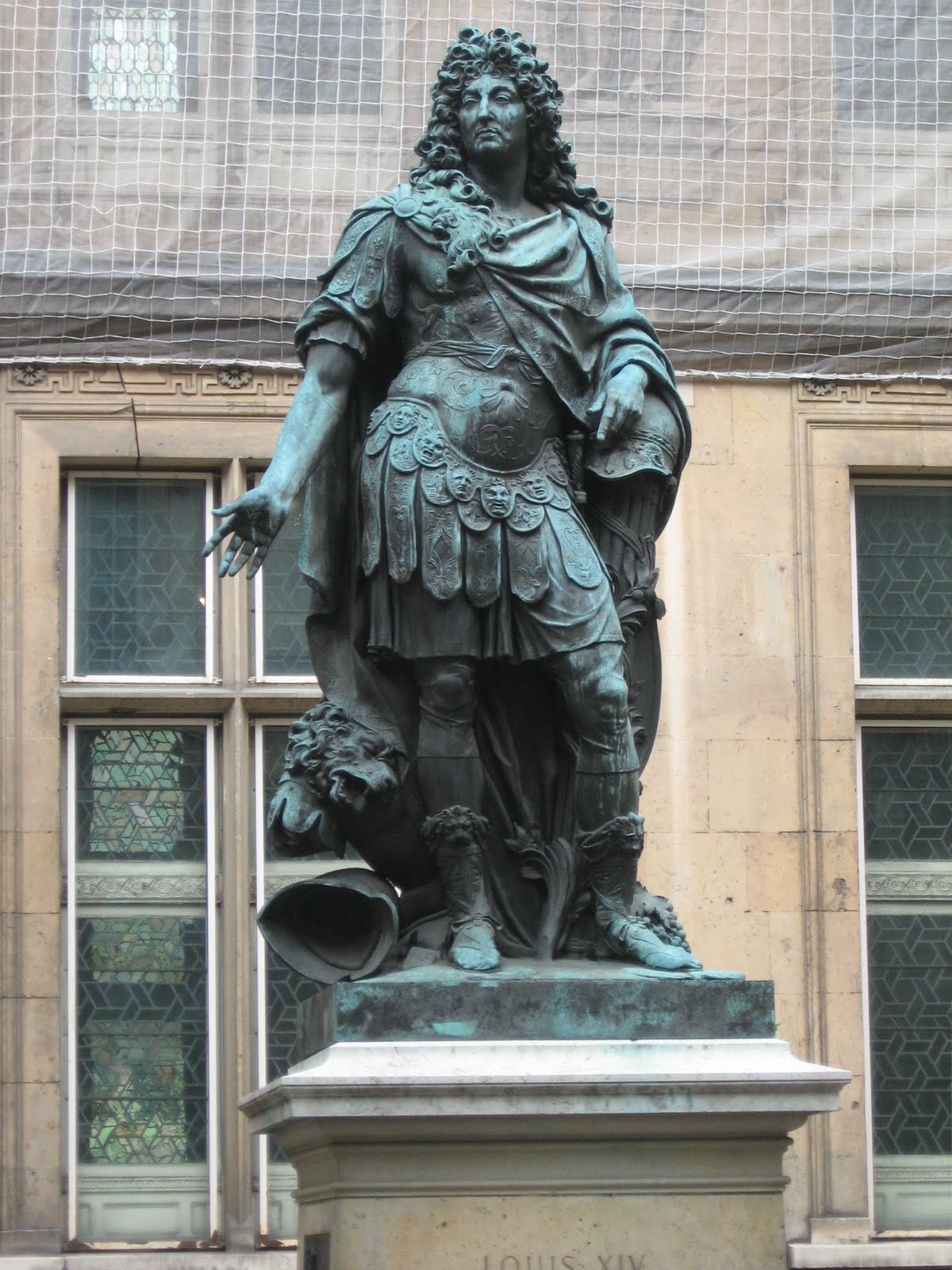
We started off in the courtyard, where a statue of Louis XIV - the Sun King - stands.
There are many scale models of parts of Paris in the museum. In this one below, you can see a tiny little Notre-Dame cathedral.
We enjoyed the Salle des Enseignes (Room of Signs) which displays signs from businesses around Paris. Here are a couple of my favourites:
One from le Coutelier (1930)
and another that was outside Le Chat Noir in Montmartre.
There were also furnishings from various eras and historical figures. I love the curtains in this room!
Le Salle de Philosophes had busts of Jean-Jacques Rousseau
and Voltaire.
I also love the parquet floor in this room.
The museum has a wonderful collection of paintings from various eras in history, including a series called Paris vu par les peintres. Many of the artists showcased in Le musée Carnavalet are not well-known (at least not as well-known as those in the Louvre or the D'Orsay), but they were worth a look nonetheless.
There was an entire floor dedicated to the history of the French Revolution. Wonderful! That is one of my favourite historical periods to teach and to learn about myself.
Here's Louis XVI, the man who caused so much trouble.
In the early years of the Revolution, commemorative pottery was made espousing the new nationalist beliefs.
Here are some relics from the Bastille, which was attacked on July 14, 1789. This date is now a national holiday, Bastille Day, in France.
And a scale model of the Bastille. Trivia question: how many prisoners were being held in the Bastille when the revolutionaries came to free them on July 14, 1789?
a. 2000
b. 270
c. 50
d. 7
The answer is d. 7. Hardly worth the effort... but the Bastille had long been regarded as a symbol of repression and monarchist power.
Here's an intriguing knick-knack. A revolutionary clock, featuring two
sans-culottes and, interestingly enough, two monkeys.
The courtyard between the two palaces was beautiful (but I didn't go out there because I couldn't figure out how to access it).
This is some work done by the dauphin (Louis XVI's son and heir to the French throne) while he was imprisoned in the Temple. It was found in his cahier d'écriture. It's so sad - he was just a little boy.
This is the furniture from Madame Elisabeth's room in the Temple Prison.
A bust of
Jean-Paul Marat, on of the most radical revolutionaries. He was found dead in his bathtub, supposedly killed by his mistress Charlotte Corday.
A bonnet rouge, the red cap of liberty worn by the leaders of the Revolution.
A French soldier. If he got off his pedestal, we'd be about the same height.
My hero Napoleon and me. I'm staring adoringly at him; he's regarding me with disdain. See, I told you he was a typical French man.
After the French Revolution/Napoleon floor, we had to pass through the rest of the museum rather quickly as they were going to kick us out. I swear their sign said they were open until 6 pm...
I took a few more photos, but I'll just show you this one. This clock of Notre-Dame is from the late 19th century.
Good bye Musée Carnavalet.
That was a great visit! I highly recommend it if you're ever in Paris. There's much more than what I showed here... and admission is free!
On our way home, we decided to find the Mémorial de la Déportation that I had been seeking the other day. Just outside the memorial, we noticed a crowd of people and some streets roped off. There's some kind of filming going on in that area just behind Notre-Dame and it looks like a World War II piece. I've been trying to find information about it on the internet, but haven't discovered anything so far. I did manage to take a few photos before they kicked everyone out of the area, but I missed the fellow riding by on his bicycle, complete with yellow Star of David sewn to his jacket, because I didn't have my camera out.
We made it to the Mémorial de la Déportation, which is dedicated to the more than 200 000 French people who were rounded up by the French Vichy government (the Nazi collaborators) and sent to concentration camps during World War II.
No... we should not forget.
So, a busy day, and then it started to rain which put an end to all the fun. The weather here is so unpredictable. I had just finished telling Sandi that we lucked out because rain had been forecast (but the sun was shining brightly) and then it poured. Oh well, c'est la vie.